Ultra-prime real estate rarely follows the same rules as the general property market. In cities like Abu Dhabi and Dubai, values in this segment are not dictated by short-lived trends or minor fluctuations. Instead, they respond to deeper forces: global wealth migration, institutional development, cultural anchoring, and long-term limits on land supply.
Mandarin Oriental Residences on Saadiyat Island embodies all of these dynamics. It is part of a structural shift in how UHNW families treat Abu Dhabi — not as a secondary investment market, but as a long-term residence option grounded in culture, stability, and architectural pedigree. Understanding this context is essential for distinguishing who this development is truly for, and who it is not.
Who Is This Development Suited For?
Mandarin Oriental Residences appeals to a very specific demographic: end-user families and global UHNW individuals looking for long-term cultural positioning, privacy, security, and architectural excellence. It is suitable for those prioritising capital preservation, quality of life, and world-class branding over investment turnover.
Who Is It Not Designed For?
Buyers seeking high rental yields, mid-prime price points, quick liquidity, or rapid appreciation cycles will not find this project aligned with their expectations. Mandarin Oriental falls firmly into the ultra-prime asset class, where holding periods are longer and returns are driven by scarcity and cultural significance rather than yield optimisation.
Understanding the Demand Cycle in Cultural Districts
High-net-worth families purchase homes based on criteria fundamentally different from those guiding traditional investors. Their priorities include cultural access, institutional stability, generous internal layouts, privacy, and global brand trust. Rental yields and trendy amenities are secondary considerations.
This explains why districts anchored by major cultural institutions—such as Museum Mile in New York, Kensington in London, and the Louvre area in Paris—retain strong long-term demand even during global economic corrections.
Saadiyat Island demonstrates the same pattern. According to Knight Frank, residential values in Abu Dhabi grew roughly 10% year-over-year between 2022 and 2024, with Saadiyat outperforming most other districts. Crucially, this growth has been driven by end-user families migrating to Abu Dhabi for stability and culture, not short-term investors.
Mandarin Oriental is positioned at the centre of this movement, catering precisely to a buyer type that behaves differently from the broader market and sustains value during slowdowns.
How Ultra-Prime Residences Move Through Market Cycles
Ultra-prime branded residences operate in a distinct market segment with its own pricing logic. The primary value drivers include limited land availability, architectural provenance, global brand equity, institutional surroundings, and protected view corridors.
This explains why Mandarin Oriental’s pricing sits far above Abu Dhabi’s average:
1-Bedroom: AED 6.5M–6.8M (≈ AED 5,800–7,000 psf)
2-Bedroom: AED 12.4M–18.1M (≈ AED 6,200–8,200 psf)
3–4 Bedroom: AED 25M–40M (≈ AED 6,500–8,500 psf)
Penthouses: AED 52M–164M (≈ AED 6,800–9,900 psf)
With Abu Dhabi’s general residential market averaging around AED 1,100–1,150 per square foot, Mandarin Oriental sits roughly five to nine times higher. This is not a deviation; it is the definition of ultra-prime positioning.
Rather than competing with other Saadiyat residences, Mandarin Oriental competes with Four Seasons Residences, Nobu Residences, ORLA, Six Senses, and other global upper-tier branded products. Buyers in this segment prioritise permanence, identity, and cultural positioning over yield optimisation.
Why Saadiyat’s Cultural District Holds Exceptional Value
The development’s location is its strongest value driver. Saadiyat Cultural District is one of the most institutionally curated masterplans in the region, featuring:
Strict height and density limits
Protected view corridors
Controlled plot releases
Museum-led urban planning
High barriers to future supply
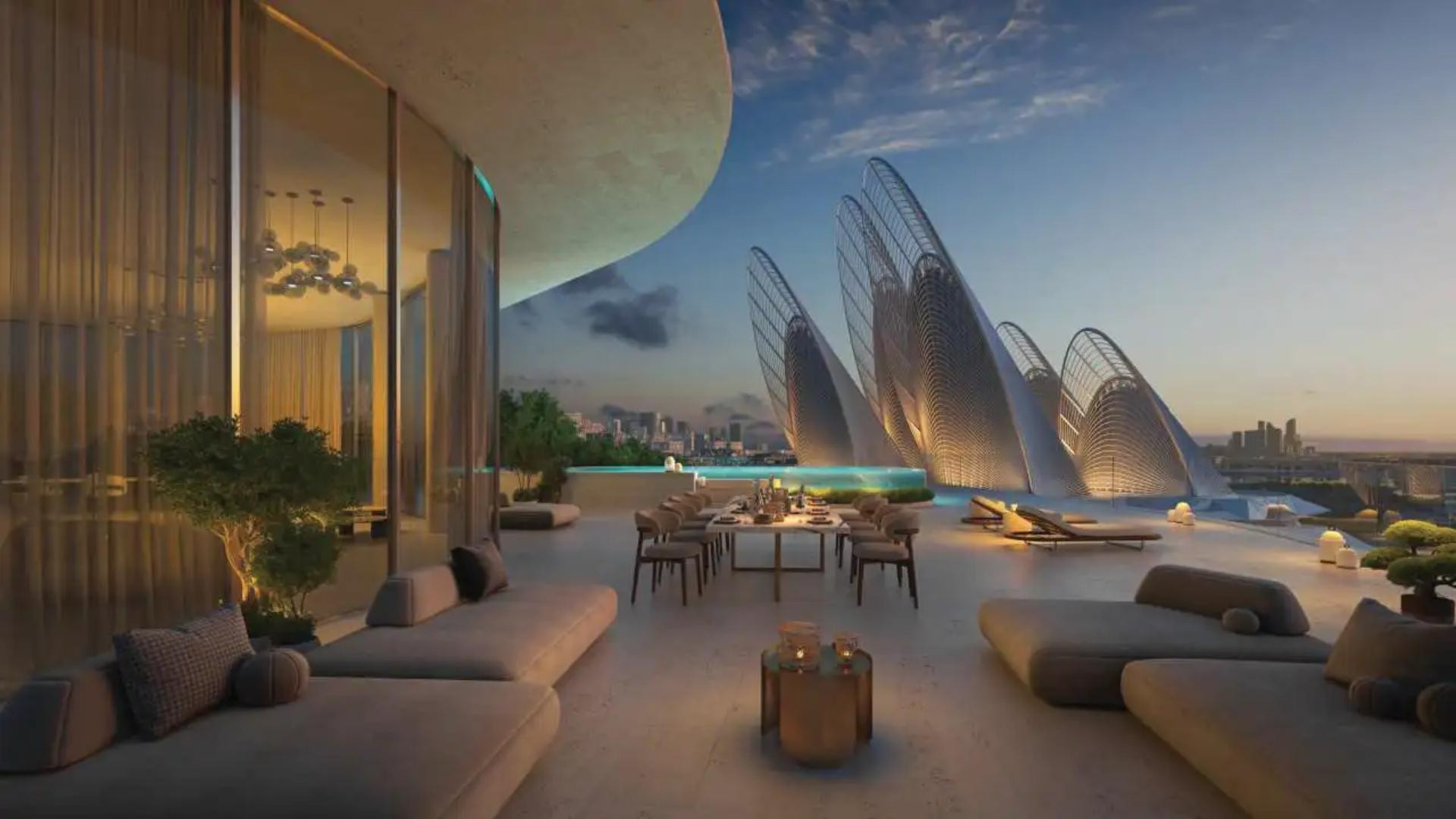
Mandarin Oriental sits directly along the Fountain Axis facing the Zayed National Museum fountains, one of the few guaranteed view corridors in the district. This level of visual permanence is rare in the region and significantly enhances long-term asset value.
Once this land is allocated, it cannot be recreated. As seen in cities like Paris, protected cultural views often become generational assets that outperform broader market cycles.
A Closer Look at the Product
Mandarin Oriental Residences is designed by Bjarke Ingels Group (BIG) with interiors by Lillian Wu Studio. The development includes fully serviced, fully furnished hotel-grade residences with:
Private pools and wellness spaces
Concierge, valet, and butler services
In-residence dining
Cinema and resident lounges
High-end furnishing packages
Elevated security and privacy
Unit sizes are significantly larger than standard Saadiyat apartments, with 2-bedroom layouts reaching 2,200–2,600 sq ft and penthouses exceeding 6,900 sq ft. This scale is intended for primary residences, not compact investment units.
Payment Structure and Buyer Profile
Aldar has implemented a payment plan designed to favour long-term end users rather than speculative investors:
10% on booking
55% during construction
35% on handover (Q3 2028)
This structure places more equity earlier in the cycle, reducing leverage risks and filtering the buyer base toward families and UHNW individuals planning long-term occupancy or wealth preservation.
Key Insights for Investors and End-Users
The development's positioning includes several strategic implications:
1. Protected Views Create Long-Term Scarcity
The museum-facing fountain axis is a permanently protected corridor, ensuring long-term value for these units.
2. Branding Alone Does Not Drive Value — Location Does
Branded residences only outperform when paired with irreplaceable locations such as cultural or waterfront districts.
3. Ultra-Prime Supply in Abu Dhabi Is Limited
With only a small number of comparable UHNW-focused developments, Mandarin Oriental effectively operates in its own category.
4. Demand Is Supported by Global Migration Trends
Increasing UHNW migration to the UAE since 2021 strengthens long-term demand for cultural district real estate.
5. High Service Charges Maintain Community Integrity
Premium services carry premium fees, filtering residents and supporting long-cycle value.
6. Delivery Timing Requires a Multi-Year Strategy
As handover approaches in 2028, buyers should anticipate a longer holding period for optimal appreciation.
7. Every Unit Exceeds the Golden Visa Threshold
This widens the global buyer pool and ensures consistent absorption.
Final Perspective: Who Should Buy Here?
Mandarin Oriental Residences is positioned at the top of Abu Dhabi’s residential landscape because of its cultural anchoring, architectural pedigree, protected land, and alignment with global UHNW migration patterns.
It is the right choice for buyers who value:
Long-term cultural positioning
Protected, irreplaceable views
Generous interior spaces
Global brand standards
Stability over speculation
It is not suitable for buyers focused on:
Short-term yields
Rapid resales
Mid-prime pricing dynamics
High-yield rental strategies
Mandarin Oriental represents a capital preservation asset rooted in cultural scarcity. It is designed for individuals and families building generational value, not for investors pursuing fast returns.